There is something I have observed over the years in my work with people, teams and organisations that continues to make me curious: most of the time, intentions are good. Generally speaking, people want to listen better, collaborate more, manage their attention better, react less impulsively, have better conversations or find different ways of dealing with pressure. Something similar happens in organisations. There is more and more talk about trust, autonomy, psychological safety, collaboration, wellbeing and more human leadership and, in most cases, I believe there is a genuine desire to do better. Deep down, we all want to feel well, safe, in a pleasant environment and surrounded by good relationships. The difficulty begins when we leave the territory of intentions and enter real life, because knowing how we would like to act is one thing; actually being able to do it when we are tired, under pressure, insecure, short of time or faced with a situation that affects us personally is quite another.
I see this constantly, including in myself, in this ongoing practice that is life. We may know perfectly well that it is important to listen before responding and still interrupt someone while they are speaking. We may believe that attention is a precious resource and spend the entire day jumping between meetings, messages, notifications and tasks. We may want autonomous teams and, at the first mistake, quickly return to control. We may genuinely believe that we want to embrace change and discover that it is much harder to do so when that change threatens a skill, a role or an identity that we have built over many years.
We have never had so much knowledge available to us, so many opportunities to learn or so many resources within reach, so I do not believe that the main problem is a lack of information or knowledge. Very often, we know exactly what would be important to do. The challenge lies in being able to access that knowledge at the moment when we need it most.
When understanding is only the beginning
In a context where everything seems to be happening faster and faster, this gap between what we know, what we want to do and what we actually manage to do becomes even more relevant. The greater the speed, uncertainty or pressure, the more easily we fall back on automatic responses, even when we are aware that we would like to act differently. It is also a question we have returned to often in our work at The School of We, and one that is present in Carlos Goga’s new book, Vivir con Dragones. The book starts from the major forces transforming the world, with Artificial Intelligence naturally playing a significant role, and inevitably leads us towards deeply human questions: what happens to us when what we once knew is no longer enough, how we respond to uncertainty, what we want to preserve, what we are willing to transform and what role we want to take in what is happening.
And this is precisely where, for me, understanding is not enough. If we want to be able to respond differently when pressure increases, it is not enough to know how we would like to act; we need to create opportunities and open up space to experiment, observe what happens within us and try out different responses.
It is through experience that we begin to discover other possibilities
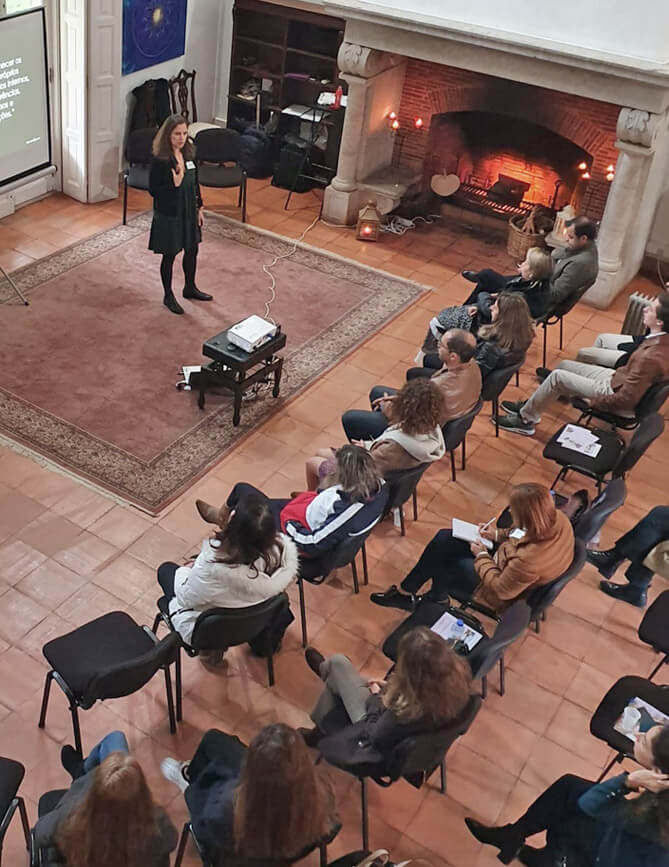
Over the years, in my work with leaders and teams, I have observed that some of the most meaningful learning happens when we create the conditions for people to experience something, rather than simply hear about a particular concept. Perhaps that is why I believe so strongly in learning through experience. When I work on listening with a group, for example, I can begin by explaining what it means to listen attentively, talking about empathy or about our tendency to prepare our response while the other person is still speaking. None of this is particularly difficult to understand. But when I invite two people to have a conversation and ask one of them, for a few minutes, simply to listen — without interrupting, offering advice or immediately bringing in their own experience — the nature of the learning changes. That is when some people realise how difficult it is not to intervene, others discover that they were barely listening because they were busy preparing their response, and others recognise, perhaps with some surprise, the impact of feeling genuinely heard. The concept is exactly the same, but it stops being merely an idea and becomes something we recognise in ourselves.
And what happens with listening also happens with attention, emotions, feedback, collaboration and the way we make decisions. A mindfulness practice can help us recognise the moment our attention drifts or the impulse to react before we have even understood what we are feeling; a facilitated conversation can make visible a dynamic that a team has been repeating for years without noticing it; an exercise can allow us to experiment with a different response from the one we usually use. Experience does not replace knowledge, but it adds an essential dimension to it: it allows us to observe ourselves in action. And only when we begin to recognise our automatic patterns do we have the possibility of trying out different responses.
Perhaps this is precisely where we can begin: not by trying to change everything at once, but by choosing a specific situation and observing more closely what happens between our intention and our response.
A small experiment
I would like to suggest a short exercise that you can do individually or adapt to a team conversation. Think of a recent change that triggered some kind of reaction in you. It may be related to artificial intelligence, a new way of working, a decision made by your organisation or any other situation that disrupted your expectations. Take a few minutes and move through these four steps.
1. Observe — What is actually happening?
Try to distinguish facts from interpretations. What do you actually know? What are you anticipating? Which part of the story are you building on assumptions?
2. Recognise — What is happening within me?
What emotions are coming up? What thoughts keep repeating themselves? What do you notice in your body? What impulse appears: to move forward, avoid, control, resist, quickly find a solution? You do not need to change anything immediately. Simply try to observe with curiosity.
3. Choose — What really matters in this situation?
What do you want to preserve? What values or principles would you like to guide your response? What impact might your decision have on you and on the people around you?
4. Experiment — What might the next step be?
You do not need to find a definitive answer. Perhaps the next step is to ask a question, look for information, talk to someone, test a possibility or simply wait until you have greater clarity. Choose a small, concrete and possible action. And once you have tried it, observe again. What happened? What did you learn? What might you adjust?
The purpose of this practice is not to guarantee the right decisions or eliminate uncertainty. It is to help us respond with a little more attention, intention and discernment.
And what happens when transformation takes place between us?
We do not live or work in isolation. What happens to me influences the people I relate to, just as their experiences and reactions influence me. A change that represents an opportunity for one person may be experienced as a threat by another. The same decision may generate enthusiasm in one part of a team and concern in another.
For that reason, these four steps can also be brought into a collective conversation.
Before moving forward with a change, a team can create space to explore what it knows and what it still does not know, listen to different reactions, identify what is important to preserve and choose small experiments that allow people to learn together. This is not about trying to make everyone feel or think in the same way, nor about turning every decision into an endless process of reflection. It is about recognising that different perspectives can add valuable information and contribute to more conscious and shared decisions.
This is also where facilitation, dialogue and experiential learning can make a difference: not by providing ready-made answers, but by creating the conditions for new answers to emerge.
The future is also built through small choices
One of the ideas I most like in Vivir con Dragones is precisely the possibility of seeing the future not simply as something that will happen to us, but as something we continue to participate in building. And that participation does not happen only through major decisions about technology, strategy or transformation. It also happens through seemingly small choices: how we listen to someone when we disagree, how we react to news that frightens us, how we introduce a new tool into a team, the courage to admit that we still do not know, or the space we give other people to take part in decisions that also affect them.
This is where I find an important part of the meaning behind the work we do at The School of We. Understanding what is changing is fundamental, but understanding alone rarely transforms anything. Good intentions matter too and are probably the beginning of many changes. But it is when we begin to put them into practice, repeatedly, individually and together, that what we believe in truly starts to show up in the way we live, work and choose to respond to what is happening.