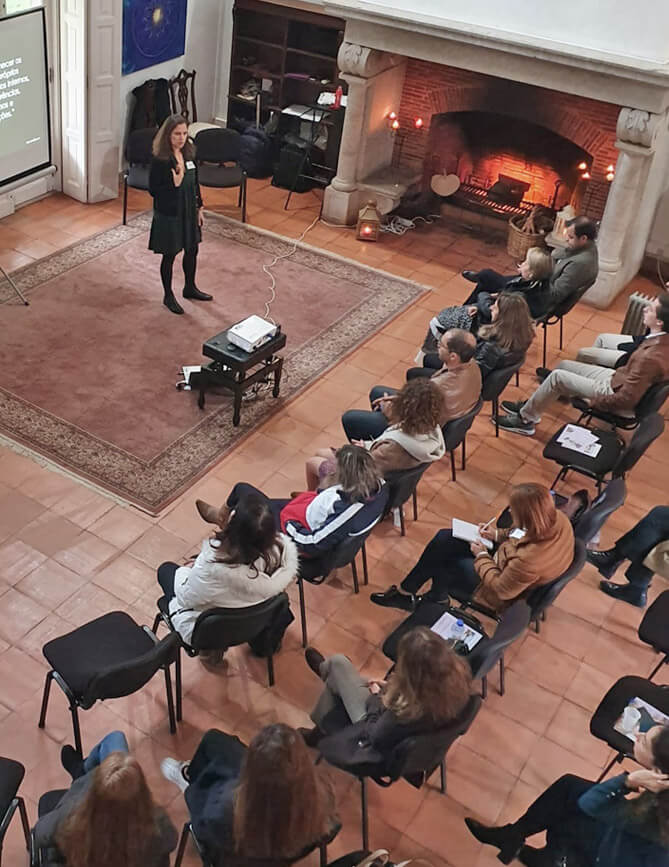
This week I had the opportunity to speak about organizational well-being at the 8th Congress of Certified Accountants, on a day marked by many conversations about transformation, technology, Artificial Intelligence and the future of work.
The reflection I brought to the Congress (and which I share through this article) comes from what I have observed throughout my 28 years of work, first within organizations and, later, working with organizations that are very different from one another. I wanted to share my perspective on what we are doing well, what we are still doing poorly and what we still need to do in the area of organizational well-being.
Well-being: from a peripheral topic to strategic integration.
There is progress that I want to acknowledge. In general, today there is greater ease and legitimacy in talking about well-being, mental health, burnout, psychosocial risks or psychological safety. Topics that, some years ago, were seen as too personal, sensitive or even difficult to bring into the work context have started to become part of the conversation.
We also have more structure and frameworks. Policies, standards and management systems have emerged that help organizations address well-being in a more consistent and organized way. In Portugal, for example, we already have a long evolution in the area of Occupational Safety and Health and have progressively broadened the perspective, with Portuguese and international standards in the areas of organizational well-being and happiness, work, family and personal life balance, and the management of psychosocial risks.
At the same time, we have started to measure and listen more. We have more academic research, more climate studies, psychosocial risk assessments, questionnaires and different indicators that seek to understand not only how employees are doing, but also which factors in the work context are contributing to that experience.
I also notice that there are more resources available, with a growing offer of information, tools, activities, programs and organizations that help companies implement well-being strategies in a more structured way.
I believe that well-being has stopped being only a peripheral topic and has entered the agenda of organizations. What I observe, however, is that entering the agenda does not necessarily mean entering the way we actually work.
We still often try to solve, superficially, problems whose origin lies in the system. We offer tools to manage stress better without sufficiently questioning what is producing it. We teach people to recover better, but we maintain rhythms that are difficult to sustain. We encourage self-care, but we continue to value cultures where permanent availability, excessive working hours or the ability to “endure” more are easily confused with employee commitment and engagement.
I say this while working myself with mindfulness, emotional intelligence and other personal development initiatives and tools. I deeply believe in their value and I know the impact they can have on a person’s ability to know themselves better, regulate themselves, gain perspective and make more conscious choices. But I also know that no individual tool can indefinitely compensate for a poorly designed work system that continues to generate ill-being.
That is why I feel there is still a long way to go, and I propose three main “movements”: deepen, integrate and listen.
Deepen, because raising awareness is important, but it is not enough. A session, a training program or a one-off initiative can open a door, but topics such as leadership, mental health, relationships, self-regulation or psychological safety need continuity, practice and time in order to translate into real changes in behavior.
Integrate, because well-being cannot continue to be a topic that belongs only to Human Resources. It has to be connected to culture, leadership, the way priorities are defined, workloads are distributed, decisions are made, performance is managed and periods of change are navigated. And this necessarily means involving leaders, not only as “sponsors” of initiatives, but as an active part of the way well-being is experienced on a day-to-day basis.
And, finally, truly listen. A well-being strategy is not designed only on the basis of anonymous questionnaires or a diagnosis carried out from time to time. It is built in a closer and more continuous way, by listening directly to people, observing, understanding what is really happening, identifying concrete needs, adjusting responses and then measuring the impact of what has been done.
When technological transformation enters the equation
Talking about organizational well-being today also means recognizing that the very conditions in which we work are changing. We cannot treat technological transformation as a simple backdrop. It affects tasks, processes, rhythms, skills, ways of making decisions and, inevitably, the way people experience and feel about work.
It is important to recognize that this transformation is not emotionally neutral. It can bring curiosity, enthusiasm and a willingness to experiment, but also insecurity, resistance, anxiety or fear. It is natural for questions to arise about our place, our autonomy, our personal and professional identity or our future. And I do not think it is possible to speak seriously about well-being while ignoring this kind of unease. We cannot speak only about stress management, balance or self-care when, for some people, what may be at stake is their own professional security or their perception of their value.
It is precisely here that the responsibility of organizations becomes even more demanding. If technological transformation affects not only tasks and processes, but also security, confidence, professional identity and expectations about the future, then the way that transformation is conducted also becomes a matter of well-being. We need to take care of the way people are informed, involved and prepared for what is changing.
We cannot eliminate uncertainty, nor promise answers that we do not yet have, but we can avoid increasing it unnecessarily. This means communicating transparently about what we know, what is going to change or is already changing, and what we still do not know; involving people in transformation processes; and truly investing in their development.
And when I say development, I do not mean only teaching people how to use new tools or develop technical AI skills. It also means helping people deal with change itself: developing critical thinking and discernment, adaptability, emotional self-regulation resources, greater tolerance for uncertainty, and the ability to continue learning and making choices when the context changes rapidly.
There is another question that I feel we talk about too little: what do we want to do with the efficiency we are gaining? If a task that used to take three hours now takes one, what do we do with the two hours that are “left over”? If every gain in efficiency automatically translates into more volume, more speed and higher expectations, we may end up with organizations that are more technologically capable and people who are progressively more overloaded. That gain in efficiency can allow us to think better, learn, deepen an analysis, improve the relationship with a client or with colleagues, collaborate, create or recover energy.
Integrating AI into an organization therefore cannot be only a technological project. It also requires a human strategy.
This is also why I continue to see well-being as a true competitive advantage. Not in the sense that one organization offers more initiatives or activities than another, but because a truly integrated well-being strategy helps to preserve and develop capabilities that we will increasingly need.
In a world increasingly transformed by AI, the future of well-being is not about protecting ourselves from change. It is about developing people and organizations capable of moving through it without losing health, judgment, the quality of relationships, discernment and freedom of choice.